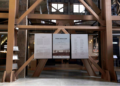
REBLOOM Festival took place on 5–7 December 2024 at Postane Istanbul, transforming the historic building into a meeting space for migrant artists and local communities. Co-organized by Inter Alia’s Outcast Europe, Association for Migration Research (GAR), Urban.koop, and Hubban, the festival brought together 14 artists from Syria, Iran, Afghanistan, Ukraine, Lebanon, and beyond to share their experiences of displacement, creativity, and renewal.
A Festival of Reconnection
REBLOOM was designed as a space where migrant artists could move beyond narratives of survival and reconnect with their roots, their art, and each other. Over three days, the festival offered an immersive program of exhibitions, performances, short films, and musical collaborations, inviting audiences to experience migration through emotion, sound, and image rather than statistics or stereotypes.
Objects that Tell Stories
At the core of the festival was an exhibition of personal objects—a broken bracelet, a necklace, a book of poetry, a feather—each carrying a story of journey and belonging. Displayed alongside the artists’ own works in painting, photography, and installation, these objects transformed Postane into a living archive of memory and resilience. Visitors described feeling “as if the objects themselves were speaking,” revealing how art can create empathy across differences.
The Dialogue Circle
On the final day, artists, researchers, and visitors gathered in an open dialogue circle titled “From Survival to Blossoming.” Here, participants discussed the everyday realities of migrant life in Istanbul—language barriers, prejudice, legal restrictions, and emotional exhaustion—but also shared visions for a more inclusive cultural future.
From this exchange, the group collectively drafted a manifesto, highlighting five key needs:
- shared cultural spaces for collaboration,
- accessible and dignified language-learning opportunities,
- public efforts to counter misinformation,
- fair legal and economic inclusion for migrant artists,
- and attention to mental health and wellbeing.
The discussion was both intimate and transformative—showing how a festival can evolve from artistic expression into collective voice and political awareness.