The EGEHUB Project: Transformation of Perception Through Memory and Artistic Practice
Gülay Uğur Göksel
Introduction
EGEHUB did not merely emerge from a general interest in community memory or from a general aspiration for living together with difference. More specifically, its main conceptual point of departure was the recognition that contemporary anxieties around migration in Turkey are deeply shaped by perception—specifically, by perceptual frameworks that have been formed through selective remembering and extensive forgetting.
Over years of research, it became increasingly clear that public attitudes toward migrants were seldom the product of empirical knowledge. They arose instead from habitual modes of seeing, learned emotional reflexes, and internalized narratives of belonging. This perceptual field, however, contained a striking contradiction: communities that today articulate distance, suspicion, or even hostility toward migrants often carry unacknowledged histories of displacement within their own genealogies.
In the Aegean region, this contradiction is especially pronounced. Many families trace their roots to compulsory population movements, Balkan expulsions, resettlement policies of the early Republic, or war-related upheavals. Yet these histories have been gradually backgrounded. They persist not as articulated narratives, but as dispersed traces in domestic practices, linguistic residues, culinary habits, and family silences. Because these memories are rarely engaged directly, they cease to inform contemporary perception.
EGEHUB emerged from the conviction that reactivating these dormant layers of ancestral displacement has the potential to reshape how communities perceive today’s migrants. This reactivation, however, cannot occur solely through archival research, public lectures, or rational argumentation. It requires methods capable of engaging the affective, sensory, and relational dimensions through which memory becomes experientially meaningful.
For this reason, the project positions artistic practice not as an aesthetic supplement but as an instrument of perceptual transformation. Art can catalyze processes that academic explanation cannot: embodied attention, sensory awareness, and the surfacing of latent historical associations. These conditions make it possible for individuals and communities to perceive—sometimes abruptly—their own historical vulnerability.
When this perceptual shift occurs, the categories that structure “us” and “them” acquire new meanings. A villager who has internalized a narrative of uninterrupted belonging may realize that their family’s presence in the region is, in fact, the result of earlier displacement. A young person accustomed to thinking of migrants as a recent threat may recognize continuity between their community’s past precarity and the struggles of newcomers. In this sense, the project’s theoretical premise is that expanded possibilities for coexistence today depend on the reactivation of suppressed memories of past displacement against collective memory.
From this premise, EGEHUB was conceived as a methodological experiment: bringing artists, researchers, and local residents into proximity long enough for perceptual, emotional, and cognitive shifts to take place. The Aegean—specifically İmbros and Alçıtepe—offered appropriate sites for exploring these dynamics due to their dense historical layers, contested narratives, and ongoing negotiations of identity and belonging.
Origins: Why EGEHUB? Why Now?
The initiative emerged through the collaboration of three partners—GAR, Kirte School, and Duvarlar Bile Biliyor—each working at the intersection of migration, culture, and critical memory.
GAR’s research over the years highlighted that policy reports, rights-based advocacy, and statistical analysis, while essential, were insufficient for addressing the affective drivers of xenophobia. Public attitudes were shaped not only by misinformation but also by perceptual frameworks anchored in emotions, assumptions, and inherited narratives.
EGEHUB builds on GAR’s earlier artistic and community-based initiatives, which demonstrated that changes in public perception toward migrants rarely occur through information-based or policy-oriented interventions alone. Rather, GAR’s previous work made evident that perception shifts emerge when individuals engage with artistic, embodied, and affective practices that activate forms of memory otherwise inaccessible through conventional public discourse. The first major experiment in this direction was The Other Stories, a multi-component project that brought together artists from different countries to work on themes of displacement, belonging, and lived experience. Through its exhibition, book, website, and podcast series, the project revealed that the arts can communicate the complexities of migration in ways that policy language cannot. Visitors often reported that the artworks prompted them to recall their own family histories of movement and loss, indicating that the project facilitated a form of self-recognition that extended beyond the immediate subject of contemporary migration.
The second step in this trajectory was the Living Together Summer Art Camp, where young participants from earthquake region together with refugee youth collaborated with artists through drawing, performance, storytelling, and experimental creative practices. GAR observed that participants began to make connections between their idea of ‘home’ and broader histories of displacement not through formal teaching but through shared artistic production. These moments made clear that memory is reactivated through practice—through doing and making alongside others—rather than through abstract discussion.
The most direct conceptual bridge to EGEHUB came from the REBLOOM Festival in 2024. This multi-day gathering offered a platform for migrant artists to share personal objects, performances, and narratives in a setting that encouraged collective reflection. A significant outcome of the festival was the formation of an open dialogue circle that led to a collectively written manifesto. This process underscored that artistic spaces can function not only as venues for expression but also as political arenas where participants articulate shared concerns, formulate demands, and reconsider their relationship to the broader society.
Together, these three projects shaped the conceptual foundations of EGEHUB. The VAHA III application formalized this shift by emphasizing the role of cultural and artistic practices in shaping collective understanding. It underscored that aesthetic, performative, and participatory approaches offer access points that conventional advocacy cannot reach: embodied experience, atmospheres of trust, and collaborative creativity. These are conditions in which defensive perceptual habits may relax, making space for latent memories and alternative interpretations to surface.
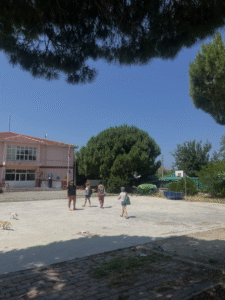
Kirte School contributed a spatial and social context ideal for such an experiment. Located in Alçıtepe, the school stands within a village formed by forced resettlement during the early Republican period. It therefore embodies demographic transformation, ruptured genealogies, and contested belonging. The school provides a rare rural environment where artistic production is integrated into everyday life, allowing encounters that exceed the boundaries of formal workshops or exhibitions.
Duvarlar Bile Biliyor, based on İmbros, expanded the project’s scope through its longstanding engagement with the island’s complex Greek-Turkish memory. Their practice had shown that local histories do not survive only through formal documentation but also through music, gesture, food, and conversation—modalities through which memory becomes a lived social process. Their involvement ensured that the project would not treat memory as an isolated topic but as a multidimensional phenomenon emerging at the intersection of personal, communal, and historical experience.
Together, these partners articulated a shared aim: to establish a sustainable cultural ecosystem that bridges artistic research with community engagement, and local memory with broader questions of migration and coexistence. EGEHUB’s ethics approval application described its research core as a participatory arts-based investigation of:
- postmemory,
- place attachment,
- affective inheritance,
- and the political dimensions of remembering and forgetting.
Thus, EGEHUB did not emerge as a commemorative project. It emerged as a response to a political and perceptual crisis, grounded in the belief that remembering one’s own history of displacement can alter how one perceives displaced people today.
Aegean Geographies of Memory: Alçıtepe and İmbros
The selection of İmbros and Alçıtepe as field sites was based on rigorous historical and sociological consideration. Both locations function as mnemonic environments, shaped not only by past events but by ongoing negotiations of identity, belonging, and narrative authority.
İmbros / Gökçeada: Fragmented Continuity and the Dynamics of Partial Return
İmbros offers a case of interrupted continuity. Although the island was exempted from the 1923 population exchange, demographic engineering in later decades led to population decline, institutional closures, and linguistic erosion. Today, partial return migration has created a complex social environment in which former residents and descendants re-engage with spaces that were physically present but socially altered.
The island’s memory is not preserved through monumental heritage. It is transmitted through:
- domestic food practices,
- linguistic shifts between Greek and Turkish,
- community events,
- and informal storytelling.
For EGEHUB, the island provided a setting where participants could observe how social memory persists despite institutional weakening. Workshops, documentary screenings, culinary encounters, and guided walks facilitated the analysis of how memory circulates through spatial cues, habits, and sensorial triggers.
Alçıtepe / Kirte: Displacement, War, and Competing Narratives of Belonging
Alçıtepe presents a different configuration of memory. Following the compulsory population exchange, its Greek Orthodox residents were displaced, and Muslim families from various regions were resettled. This demographic restructuring was layered upon the land’s prior role as a major battleground in the Gallipoli campaign. The material residue of war—shrapnel, bullet casings, and other remnants—continues to surface through agricultural activity.
These two layers—war memory and resettlement memory—intersect with contemporary social dynamics. Neighboring Behramlı’s proclaimed Romani community experiences marginalization, while Seddülbahir maintains a narrative of uninterrupted belonging. Together, these elements produce a complex memory environment in which different histories are emphasized or minimized depending on political, social, or familial factors.
For EGEHUB, Alçıtepe offered a landscape in which the interaction between suppressed memory and present-day perception could be systematically examined. It provided conditions where artists and researchers could observe how memory emerges not only as narrative but as material, spatial, and behavioral evidence embedded in everyday life.
Method: Residency as Research, Research as Encounter
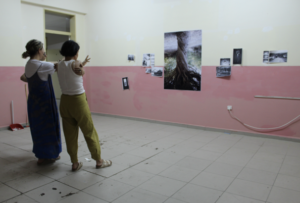
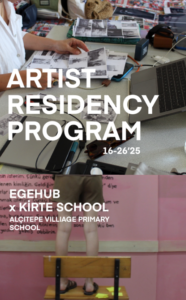
EGEHUB approaches artistic residency not as a platform for individual production but as a research methodology. This distinction is fundamental. Rather than inviting artists to produce work in isolation, the project structured residency as a collective, immersive, and situated form of inquiry. The core methodological assumption is that memory is not accessed primarily through narration but through spatial, sensory, and relational engagement, and therefore, research must be configured in ways that elicit these forms of engagement.
A central methodological principle of EGEHUB is that knowledge emerges from co-presence—from sharing space, time, and daily practices.
Rather than dividing participants into observers (researchers), creators (artists), and sources (villagers), the project treated everyone as co-inhabitants of a shared field. This arrangement intentionally blurred roles and created conditions for relational epistemology, where understanding arises through proximity rather than interrogation.
During the fourteen-day Alçıtepe residency, research unfolded through ordinary activities rather than formal sessions.
Examples include:
- preparing meals collectively,
- discussing local history during routine errands,
- observing agricultural routines,
- accompanying residents on short visits or chores,
- sitting outside in the evenings while conversations shifted between topics.
These moments, while appearing informal, constitute the empirical core of the methodology. They provide insights into memory transmission, intergenerational dynamics, and community perception that structured interviews would not elicit.
The project draws on theoretical discussions of agonistic memory, which rejects reconciliatory or sanitized narratives and instead maintains space for conflicting histories to coexist.
EGEHUB embraced this framework by encouraging participants to:
- hold multiple, sometimes contradictory, accounts simultaneously,
- resist reducing memory to a singular storyline,
- identify power asymmetries embedded in official narratives,
- and recognize how selective remembrance shapes the politics of belonging.
In this way, the methodology facilitated an understanding of memory that is neither celebratory nor accusatory but structurally and historically situated.
Art as a Mode of Courage
One of the project’s key findings is that artistic practice enables forms of courage that discursive methods rarely achieve.
Artists described moments where:
- personal memories resurfaced unexpectedly,
- connections between their own family histories and local narratives became visible,
- assumptions about belonging were unsettled,
- and perceptual boundaries shifted.
Art facilitated these shifts not by illustrating history but by creating conditions for engagement that made forgotten or unacknowledged histories perceptible.
Art, in this sense, functions as:
- a diagnostic tool
- a methodological instrument
- and an ethical practice
- Local Perceptions: Shifts Across Three Days
Across interviews, conversations, and spontaneous remarks, several perceptual shifts emerged:
- Rediscovery of Ancestral Displacement
Villagers reconnected with their own intern-regional histories of forced movement. Artworks acted as catalysts for remembering what had remained dormant.
- Recognition of Shared Vulnerability
Many articulated parallels between their ancestors’ displacement and today’s refugees:
“Syrians came here just like us.’
- Strengthened Dialogue Between Artists and Villagers
Residents felt “supported and embraced,” and artists felt the same in return. A unique communicative language formed even where verbal language failed.
EGEHUB as Memory Activism
EGEHUB’s approach can be defined as memory activism—the use of artistic and participatory practices to challenge selective remembering and cultivate perceptual openness.
Key conceptual pillars include:
- postmemory: understanding how descendants inherit the emotional architecture of histories they did not experience directly,
- agonistic memory: maintaining space for conflicting narratives without forcing reconciliation,
- artivism: using artistic forms as interventions in political and social debates.
Within this framework, EGEHUB:
- destabilizes dominant historical narratives,
- foregrounds marginalized genealogies,
- resists simplified accounts of identity,
- and repositions perception as a political site.
Why Art? Why Community? Why Now?
In a period marked by rising xenophobia, rapid political polarization, and widespread historical amnesia, EGEHUB proposes a different trajectory:
- slowing down,
- listening,
- situating knowledge,
- activating suppressed memory,
- embracing conflict as analytical material,
- practicing co-presence,
- and creating new perceptual pathways.
The project rejects nostalgia and romanticization. Instead, it emphasizes that memory, when activated through art, becomes:
- a diagnostic tool,
- a mediator of perception,
- and a resource for imagining new forms of coexistence.
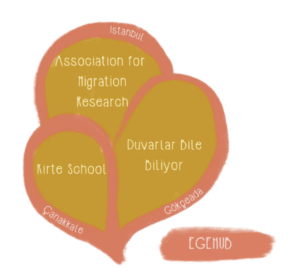
image credit: Julia Hoffmann – from Mosaics & Circles
İstanbul
GAR – Association for Migration Research
gocarastirmalaridernegi.org/en/
Association for Migration Research (GAR) was established in September 2017 in Istanbul by academics specializing in migration. Since its inception, GAR has grown into a multidisciplinary platform with the participation of scholars from various fields who have worked across universities and civil society organizations. From the outset, GAR has pursued a mission of producing critical knowledge, supporting research and researchers, documenting and making visible the rights violations faced by migrants and refugees, and contributing to evidence-based policy-making through rights-based knowledge production. Over the years, GAR has also increasingly distinguished itself as an artistic and cultural association. Through projects such as Öteki Hikâyeler (The Other Stories), the EGEHUB residency and exhibition program, its youth-focused summer camp on migration and memory, and the REBLOOM Festival, GAR has integrated arts-based methods into migration research and public engagement. These initiatives have expanded GAR’s scope beyond traditional academic work, creating participatory spaces where artistic practices, community narratives, and interdisciplinary research come together to foster new forms of dialogue, solidarity, and collective reflection on migration.
Çanakkale
Kirte School
www.instagram.com/kirteschool/?hl=el
Kirte School, established in 2023, is an independent art initiative that emerged from the repurposing of an old-closed village school in Alçıtepe, Çanakkale, for artists and local residents. To sustain this space, we are working in collaboration with the village administration. The school consists of a two-story building. On the upper floor, one of the four classrooms has been converted into a workshop, another into an artist’s accommodation room, and the remaining two have been designated for exhibitions, and a garden. Artists stay in the village for a set period and use the school as their studio.
İmros
Duvarlar bile Biliyor
Duvarlar Bile Biliyor initiative, established in 2020, explores the migration memory of Imbros (Gökçeada) through art, music, and community-based activities. By uniting local and international artists,current inhabitants, and musicians, we foster an interdisciplinary dialogue on displacement, cultural transformation, and collective memory. The program features workshops, exhibitions, music and dance performances, and culinary experiences reflecting the island’s multicultural past and present. Through found-object installations, Greek dance workshops, and oral history panels, we highlight deep connections between people, places, and migration. A photography exhibition documenting Imbros’ transformation serves as a visual anchor, ensuring migration stories are preserved and shared.