To Whom Does the Wind Open Its Door
EGEHUB ARTIST-IN-RESIDENCE PROGRAM EXHIBITION
Alçıtepe Village Primary School / Kirte School
Thursday, June 26, 2025
Organized as part of the EGEHUB program, the exhibition “To Whom Does the Wind Open Its Door” offers a space of encounter where the artists’ individual creative processes converge into a collective narrative. The artist-in-residence program held at Kirte School in Alçıtepe Village forms the foundation of this multi-layered exhibition.
The exhibition brings together the traces, witnesses, and time-woven layers of Alçıtepe through the diverse perspectives of the participating artists. Centered around themes such as borders, cultural heritage, home and belonging, grief, and displacement, the works presented invite the viewer into a polyphonic encounter by placing different forms of storytelling side by side.
Participating Artists:
Dilek Yaman
Ferhat Tunç
Meli R. Öztürk
Zelikha Z. Shoja
Büşra Aydagün
Exhibition and Accompanying Events
The three-day exhibition and program in Alçıtepe unfolded as a constellation of artistic practices, community encounters, and perceptual shifts. Rather than operating as a traditional show, the program functioned as an encounter space—a geography in which villagers, artists, and researchers entered into layered conversations about displacement, memory, and belonging.
What emerged in Alçıtepe was not only an exhibition but a shared act of remembering—a temporary, fragile, and deeply meaningful reanimation of histories long held silently in homes, gestures, soil, and family stories. Across workshops, performances, walks, and performance play, each event opened another door through which local residents could recognize their own genealogies of rupture, settlement, and continuity.
26 June – Exhibition Opening: To Whom Does the Wind Open Its Door?


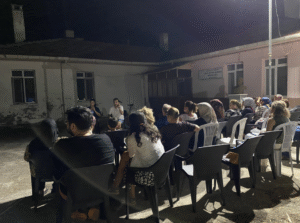
On the evening of June 26, Kirte School became a threshold. Approximately 150 villagers entered the old primary school—some hesitantly, some carried by the curiosity of their grandchildren—to discover that the familiar spaces of their childhood-the school had been reassembled into a living art gallery.
The exhibition, titled To Whom Does the Wind Open Its Door?, served as the culmination of the residency but also as its starting point. Each work embodied the entanglement between lived histories and contemporary perception, inviting villagers to see themselves and their environment refracted through artistic sensibilities.
Dilek Yaman — Cereyan / Guguk Kuşu

Yaman’s photographic sequences were rooted in the textures and absences of familiar spaces. Many residents paused in front of her images with curiosity. Her framing of abandoned spaces, bent trees, worn walls, and minute architectural traces prompted viewers to recognize that the landscape they live with every day holds stories they no longer articulate. Villagers repeatedly asked about “the tree”—a crooked, resilient olive tree that appears in one of her images—wondering:
“Is this our tree?”
Zelikha Z. Shoja — Gel Benimle Helva Yap, The Last Mother, To Those That Remained

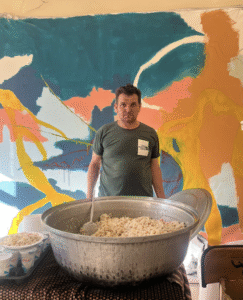
Zelikha Z. Shoja’s works—, The Last Mother, and To Those That Remained—bring together ritual, grief, and the fragile continuities of displacement through intimate materials and gestures. In her helva performance, created amid unfolding violence in the region, she invited villagers into a shared act of mourning that linked Alçıtepe with Afghanistan, Iran, Gaza, and Çanakkale through the simple, collective ritual of cooking. The Last Mother transforms a family quilt into a compressed carrier of migration routes, evoking the ways textiles become vessels of memory during forced departures. Zelikha received this piece from a fourth generation family in Alçıtepe and later returned the work to them. While looking at the piece, the family said that witnessing its transformation prompted them to remember the hardships their ancestors endured, and made them wonder “what would happen if this were happening now?” For them, the work became a way to honor their ancestors’ sacrifices and to feel gratitude for their present circumstances.
Büşra Aydagün — Returness/Geri Dönenler

Aydagün’s video essay traced the routes of migrants from Bulgaria-Romania Border and the symbols carried across borders. Families whose grandparents had arrived in Alçıtepe from Bulgaria, Romania, or Thrace responded emotionally. “My mother came here just like that,” one resident said, pointing at the screen. The artwork transformed their inherited stories from vague knowledge into vivid recognition.
Meli R. Öztürk — Cultural Return / Kültürel İade

Öztürk’s research-based board game added an unexpected dimension to the exhibition. The game, centered on the politics of repatriation, invited villagers of different ages to debate the fate of artifacts displaced through colonialism, war, and trade. The game became a micro-political site where justice, memory, and cultural loss were negotiated in real time.
Ferhat Tunç — The Evolution of Borders

Tunç’s experimental cartographies installations invited visitors into conversations about borders, routes, and the emotional geography of migration. While some villagers connected immediately with the visual language of mapping, others responded more intuitively, describing his pieces as “paths we remember but do not speak of.” In a village shaped by war, forced resettlement, and agricultural survival, these silent paths echoed their own stories of movement.
Emotional Atmosphere of the Opening
The opening evening reached a collective emotional climax. Artists, villagers, and researchers found themselves in an emotional state—some silently, some openly. One participant said:
“It was a step toward collective healing.”
The exhibition created a space where villagers could grieve their unspoken histories while recognizing parallels with contemporary migration. Several mentioned that their views on Syrian and Afghan migrants shifted, even subtly, as they recalled their own ancestral vulnerabilities.
28 June – Closing Events: Embodiment, Play, Sound, and Performance
The final day wove together movement, play, music, and performance—modalities that allowed villagers to experience memory not intellectually, but bodily.
Music Session


(Udi Halil Demirel & Neyzen Cengizhan Çelikkaya & Hülya Demirel)
Music dissolved distance. Quiet murmurs turned into shared singing, and several elders said the melodies reminded them of “places we once came from.” Music revealed that emotional belonging often survives linguistic and national borders.
Performance: displaced
(Ertürk Erkek & Ezgi Adanç & Anet Sandra Açıkgöz)
Displaced – Installation Performance / Nomad Performance
Ertürk Erkek (Director / Performer)
Ezgi Adanç (Performer)
Ozan Ömer Akgül (Project Consultant)
Özge Ayşegül Fişenk (Stage Design)
Text: William Saroyan
About the Performance:
Displaced is an interdisciplinary installation performance based on the journey of migrants crossing the Storskog border between Russia and Norway using bicycles—the only vehicles permitted without registration. Starting from this small yet telling point within the long history of migration, the work engages with notions of the road, the border, belonging, the past, the future, hope, and sorrow.
“Where is a person’s homeland? (in Armenian and English)
Is it a particular piece of land? Is it the rivers there? The lakes? The sky? The rising of the moon? The sun? Is a person’s homeland the trees, the vineyards, the grass, the birds, the rocks, the hills, the mountains, and the valleys? Is it the climate? The spring, summer, and winter of a place? The huts and the houses, the streets of the town… Is it the tables and chairs, the tea and conversation? Is it the peach ripening on the branch in the heat of summer? The dead lying in the soil? Is it the sound of the language spoken everywhere under that sky? The song that rises from the throat and the heart? The dance? Is a person’s homeland the prayers of gratitude offered to air, water, earth, fire, and life? Their eyes? Their smiling lips? Their sorrow?”
(William Saroyan)
A discussion with the audience on migration and performance was held at the end of the event.
The performance displaced acted as a culmination of the residency’s themes. Its linguistic layer—spoken largely in Armenian, a once-familiar but now distant Istanbul language—initially seemed ambigious to the viewers. Yet this linguistic displacement opened interpretive space: villagers found meaning in movement, spacing, rhythm, and breath.
From the post-performance discussion:
– Children said the performers looked like they were crossing a minefield.
– Adults interpreted the gestures as border crossings.
– Someone asked what they carried in their bags; answers included “photos,” “yorgan,” “money,” “everything we couldn’t leave behind.”