Online Theoretical Foundations
Before any field encounters, EGEHUB developed a shared conceptual vocabulary through a series of online lectures that articulated the theoretical, historical, and political frameworks shaping the project. These sessions were essential in aligning expectations, clarifying methodological principles, and establishing a common ground among artists, researchers, and cultural practitioners.
The lectures covered:
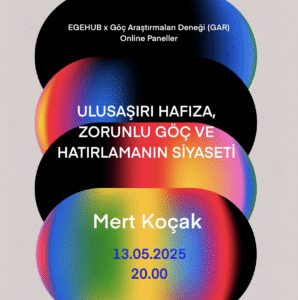
- Transnational memory and forced migration (Dr. Mert Koçak-GAR), focusing on how memory circulates across borders through digital memorial practices, counter-monuments, and diasporic narratives.
- Art as relational remembrance (Dr. Gülay Uğur Göksel-GAR), drawing on Winnicott’s theory of potential space and Patočka’s notion of the “solidarity of the shaken,” demonstrating how art can function as an intermediary zone where suppressed memory becomes perceptually accessible.

- State memory vs. local remembering in Çanakkale (Prof. Dr. Gencer Özcan-Istanbul Bilgi University), outlining how institutionalized battlefield narratives shape public perception while obscuring alternative histories.

- Photography as ethnographic testimony (Dr. Besim Can Zırh-GAR), showing how visual documentation provides insight into in-betweenness, absence, and the reconfiguration of cultural identity.

These sessions did not aim to produce consensus. Instead, they provided a multi-perspectival framework emphasizing:
- that memory is conflictual, not unified;
- that perception is shaped by institutional power;
- that artistic and ethnographic methods can illuminate what formal archives silence;
- and that the Aegean’s layered histories require analytical tools sensitive to contradiction.
This theoretical grounding prepared participants for the complex perceptual and emotional terrain of İmbros and Alçıtepe.