A Social Network Analysis on the Rise of Anti-Immigrant Discourse in Turkey
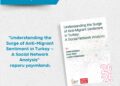
The Association for Migration Research (GAR), in collaboration with the Friedrich-Ebert-Stiftung (FES) Turkey Office, has published a new report titled “Understanding the Surge of Anti-Migrant Sentiment in Turkey: A Social Network Analysis.”
This comprehensive report examines anti-immigrant discourse circulating on the social media platform X (formerly Twitter) between 2016 and 2023. By analyzing digital conversations generated around the hashtags #SuriyelilerSuriyeye, #SuriyelilerDefolsun, #ÜlkemdeSuriyeliİstemiyorum, and #SuriyelilerGeriDönsün, the study seeks to answer a core question:
“By whom, and how, is anti-immigrant discourse being disseminated?”
Key Findings of the Report
1. A Shift Driven by Elites
Anti-immigrant discourse has been shaped not by spontaneous public reactions, but by politically connected and organized actors. The establishment of the Zafer Party in 2021 marks a turning point that institutionalized these narratives.
2. Politically Intensified and Targeted Messaging
The discourse has increasingly centered on state institutions and political figures, turning migration into a tool for political confrontation.
3. Event-Driven Waves
Sharp spikes in anti-immigrant messaging were observed during the 2019 local elections, the 2023 general elections, and the February 2023 earthquakes. This indicates that anti-immigrant discourse becomes strategically intensified during periods of political competition and crisis.
4. Slogan Consolidation
Over time, the hashtag #SuriyelilerSuriyeye overshadowed the others, becoming the central marker of anti-immigrant rhetoric.
5. Citizens as Passive Observers
Most users occupy a passive position, merely exposed to these narratives. Active participation comes predominantly from political or organized accounts.
The report concludes that anti-immigrant discourse in Turkey is not the product of widespread public anger but rather a politically driven and digitally coordinated phenomenon.
This perspective reveals how misinformation, political polarization, and scapegoating practices are reproduced in digital spaces, showing that debates on migration are shaped not only socially but also through deliberate political strategies.
Policy Recommendations
-
Strengthening legal protections and preventing systemic discrimination,
-
Increasing the involvement of civil society and academia in combating misinformation,
-
Promoting solidarity and dialogue between migrants and host communities,
-
Enhancing media literacy and encouraging critical reflection on stereotypes.
You can access the full report here: [Report Link]