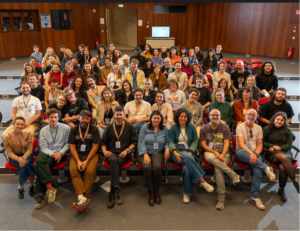
GAR has been a member of Reset! — the European network of independent cultural and media organisations — for some time now. Going to Athens for the annual General Assembly and Forum felt like finally showing up properly: meeting in person the people we had only known through screens, understanding from the inside how the network actually works, and thinking together about where things are going.
These are some notes from those three days. More like what stayed with me afterwards.
What Reset! is, and why it matters to us
Reset! was created in 2022 in Lyon. It now brings together 165 member organisations across 34 countries — community radios, music venues, art spaces, interdisciplinary platforms, media collectives, festivals. What holds them together is a shared condition: independence. Not affiliated with or fully controlled by public authorities. Not dependent on large private corporations. Operating from a diversified economic base that tries to keep autonomy real rather than just nominal.
The network is honest about the paradox this creates. Independence is your greatest strength and your greatest vulnerability at the same time. It gives you the freedom to act as you wish. It also limits your ability to secure the funding you need to keep going. Reset! exists to work with that tension — to connect organisations navigating it, to document what is actually happening across Europe’s independent cultural and media sectors, to equip members with knowledge and tools, and to advocate at the policy level for independence to be recognised as something worth protecting.
GAR joined because we share that condition. And because we believe that organisations doing migrant-focused cultural work occupy a particular position within it: we are among those most likely to face the consequences of speaking, and most in need of the kind of collective backing a network like this can offer.
Three days, and what happened in them
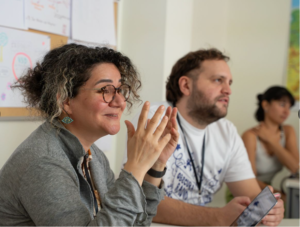
The General Assembly on 6 and 7 April was held at the Goethe Institut Athens, hosted by Culture for Change, a Greek network representing over 100 cultural professionals. More than 70 members came together for two days of work: reviewing what the network had done over the past year, meeting in working groups, addressing difficult questions about BIPoC representation within Reset! itself, and discussing the values the network wants to hold and act on.
The Living Library — a format where members exchange expertise directly with each other, through conversation rather than presentations — ran for the first day. It is one of Reset!’s better ideas: an acknowledgement that the knowledge in the room is distributed, and that the most useful thing a network can do is create conditions for it to travel between people who would not otherwise meet.
Two new working groups were launched during the assembly: one on Artistic Freedom, and one on Local Public Authorities. Both are relevant to GAR in ways I will come back to.
On 8 April, the public Forum explored digital independence across three of Athens’s independent cultural venues — the Goethe Institut, TAF (The Art Foundation), and Romantso. Workshops, roundtables, screenings, artistic performances. A live coding demonstration. A performance called A Journey into Palestine. The question running through all of it: how do independent cultural and media organisations develop an ethical relationship with digital tools and platforms, and resist the kind of corporate and algorithmic capture that is steadily reshaping the conditions under which independent culture can exist? Athens was a good city for this conversation. Its independent scene is present, organised, and politically aware. The venues were not incidental backdrops.
The first evening
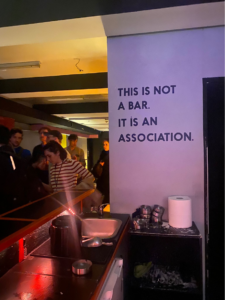
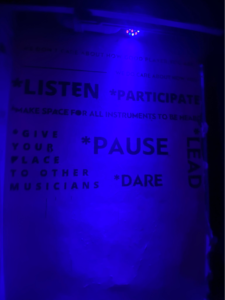
On the first day, after the formal sessions ended, the group moved through the city on an alternative tour. We visited a space called a free thinking zone — Οίκος ανοχής σκέψης, house of tolerance of thought. Then we went underground, into a music venue. On one wall, in large letters: this is not a bar. It is an association. On another wall, the rules of the space: listen, participate, make space for all instruments to be heard, give your place to other musicians, pause, dare, lead. A flyer introduced UnderAthens, the association behind the space — built around a shared vision, open to every creator, refusing to treat individuals as commodities.
I found myself thinking about that wall text for the rest of the three days. Not because it was surprising, but because it was exact. It named something that is often left implicit: that the choice to organise collectively, to write your own rules, to open your doors as an association rather than a commercial entity, is itself a political act. And it is a form of practice that most European artistic freedom policy does not know how to name, let alone protect.
GAR’s own artistic path
GAR was founded as a research association — the Association for Migration Research — focused on documenting and analysing migration and its effects on people’s lives. That work has not stopped. But over the last six years, something else has grown alongside it.
We came to understand that research without storytelling reaches only some of the people it needs to reach. And that the experience of migration carries dimensions — aesthetic, emotional, bodily — that data and analysis alone cannot hold. So we began making space for art.
Through EGEHUB, we brought together researchers and artists around the Aegean migration route, exploring memory, loss, and the politics of the sea through exhibitions and interdisciplinary practice — including the exhibition To Whom Does the Wind Open Its Door?, shown in Alçıtepe in June 2025. Through The Other Stories, we created platforms for migrant voices to tell stories that mainstream media routinely ignores or distorts. Through the Living Together Summer Art Camp, we brought young people together across difference, using creativity as a tool for healing and solidarity. And through the Rebloom Festival — now in its second edition — we have built a migrant-led artistic space that centres the experiences of those living migration from the inside, with a particular focus on gendered dimensions of displacement and dominance.
These are not add-ons to GAR’s research work. They are a different mode of the same commitment: to take migration seriously as a human experience, not only a policy problem, and to make space for the people living it to define what that experience means.
Artistic freedom and why it is not a peripheral concern for migrants
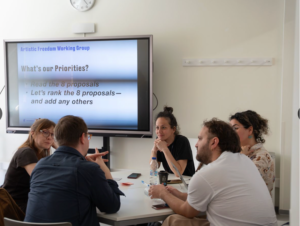
The newly launched Artistic Freedom Working Group is where GAR wants to place its energy within Reset!. Because artistic freedom, as a policy question, lands very differently depending on where you stand.
When an artist cannot speak, create, or perform without fear — fear of losing funding, losing a platform, losing a visa — the chilling effect is not evenly distributed. It concentrates among those with the least institutional protection, the least legal security, and the fewest alternative pathways. Migrant artists frequently exist at multiple points of precarity at once: uncertain residency, limited access to public funding, dependence on host organisations that may themselves be under political pressure. The kind of economic coercion that the Artistic Freedom policy work being developed through Reset! correctly identifies — where financial support is conditioned on ideological alignment or silence — hits hardest those who can least absorb the cost of refusal.
Self-censorship is one of the most significant effects of this pressure. It is also the hardest to document, because it leaves no official record. People simply do not make the work they might otherwise have made. They do not say the thing they might otherwise have said. European policy frameworks name self-censorship as a concern, but they do not yet track it as a measurable indicator, and they do not follow it to where it falls most heavily.
There is a larger question underneath this, about whose stories get told and whose voices shape what European culture considers worth funding, worth platforming, worth preserving. When resources follow ideological alignment with dominant national narratives, migrant perspectives — which are by definition often in tension with those narratives — are among the first to be marginalised. The homogenisation of cultural expression is not abstract. It is what happens when the spaces that would carry other stories cannot sustain themselves.
Three things worth pushing for
GAR’s contribution to the Artistic Freedom Working Group will centre on a specific argument: that migrant artists need to be named explicitly in European artistic freedom frameworks, not subsumed into the general category of “marginalised communities” and left there.
Beyond that, there are three areas where the current policy conversation could go further. Freedom of association — the right to self-organise as artists collectively, to form and sustain spaces like the one we visited in Athens — is largely absent from most existing proposals. The policy conversation tends to protect institutions. It does not yet have strong language for collectives, informal networks, self-organised spaces, or community groups. That gap is worth addressing. Economic rights, similarly, cannot remain emergency plumbing — reactive grants for artists at risk, rather than a structural framework of fair contracts, income standards, and social protection. Economic precarity is not a side effect of artistic freedom violations; it is often the mechanism through which suppression operates. And equality of opportunity — the active making of room, not just the absence of formal barriers — deserves to become the operative principle in how European cultural funding is designed, rather than simply a commitment to non-discrimination that stops short of actually changing access.
These are suggestions to contribute to a conversation, not a list of demands. The Artistic Freedom Working Group is a space for exactly this kind of exchange, and GAR is joining it in that spirit: with things to offer, and with things to learn.
What solidarity looked like across the three days
Solidarity was present throughout the assembly and forum in ways that felt substantive rather than performative. The BIPoC Representation Working Group addressed questions about who is included in “European” independent culture and on whose terms — questions that do not have easy answers but need to be asked repeatedly. The Non-EU Countries Working Group acknowledged that the network spans geographies with very different legal protections, economic conditions, and levels of exposure to political pressure. The forum’s programme included voices from Ukraine, Georgia, Belarus, Palestine, and beyond — people whose relationship to independence and freedom is not a policy abstraction but a daily reality.
Reset! is not a finished or settled project. It is a network building itself across 34 countries with different histories and different needs, and it is honest about that. That honesty is part of what makes it worth being part of.
What stays
The wall in Athens said: make space for all instruments to be heard. Give your place to other musicians.
That principle is not only about music. It is about how institutions are built, how networks operate, how policy is written. It asks whether the people and organisations with the least power are genuinely included — not as beneficiaries or as case studies, but as participants who shape the conversation.
GAR has been working on that question for years, through research and increasingly through art. Athens reminded us that we are not working on it alone.
The Reset! General Assembly & Forum took place in Athens, Greece, 6–8 April 2026, hosted by Culture for Change. Reset! has 165 members across 34 countries. More information at reset-network.eu. https://reset-network.eu/
GAR’s artistic programme: gocarastirmalaridernegi.org/en/garart
Gülay Uğur Göksel is an Associate Professor of International Relations at Istanbul Bilgi University, specialising in political theory, migration, and recognition and a founding member of GAR.